Tiefgrün
Case study: precision weeding PWA
Live machine data in the field, without climbing into the cab
An installable web app for precision weeding, offline-capable and with guided error handling.
For processes no off-the-shelf software covers. We build them with you, in your repository, with tests from day one.
«The process lives in Excel, emails and three people's heads.»
«The standard software almost fits. The almost costs us every day.»
«Our team is good, but too small for the roadmap.»
Five steps, so you always know where your project stands.
An installable web app for precision weeding, offline-capable and with guided error handling.
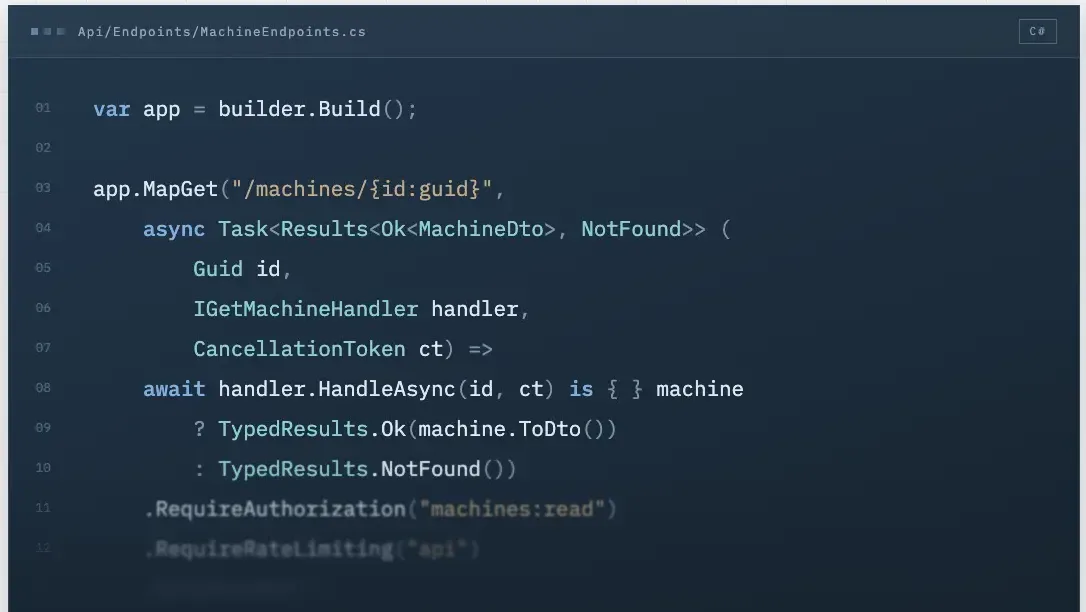
An ASP.NET Core Web API is one part of the job, not the whole of it. We build the REST endpoints, the data model behind them and the interface in front, so that what you end up with is a web application people actually use.
Blazor when you want to keep C# end to end. Angular when your team is at home there, and we are very fond of Angular signals. React when it fits. The choice follows your team, not our taste.
Architecture, API and unit tests are part of development for us, not something bolted on afterwards. That keeps your application changeable long after we stop working on it every day.
.NET is our focus and where our experience runs deepest. Around it we pick whatever suits your project.
Steven Giesel maintains bUnit, the component testing library most Blazor teams already have in their test projects. That is not a badge on a slide: it means we have read the framework from the inside, and we know which parts of it hold up under a real application.
We build new Blazor applications, take over ones that have stalled, and move WebForms and MVC code bases across without a rewrite from zero. This website runs on Blazor and .NET 10, so everything we recommend is something we run ourselves.
More on Blazor development and consulting
The testing library for Blazor components, maintained by our founder. Open source, and used by teams far beyond our own projects.
Visit the bUnit project siteFrom the first component to production, with a render model chosen for your users rather than for the demo.
Moving a grown ASP.NET application to Blazor page by page, so the product keeps shipping while the migration runs.
A shared component set your teams actually reuse, accessible by default rather than audited afterwards.
A test suite that covers rendering, state and interaction, set up by the people who maintain the tool.
Static server rendering, interactive server, WebAssembly or a mix. We pick per page, not per project.
Finding the re-renders, the oversized payloads and the circuit problems that make a Blazor application feel slow.
We work in your repositories, your reviews and your standups. Your team keeps ownership of the product, we add pace and experience.
An empty repository is pleasant but rarely the reality. We work just as well inside systems that have grown over years, improving them step by step instead of rewriting everything at once.
We have worked with .NET for many years, including a Microsoft MVP award and contributions to open source. You notice it in the decisions we make early in a project.

“Given today's security standards and the many interfaces of our overall system, we have always achieved a first-class, high-performance solution.”
We do not only build, we pass the knowledge on. Steven Giesel runs workshops on ASP.NET Core web APIs, in German or English.
Both are possible. We strengthen your existing team and work to your standards, or we build the application together with you from the start. Which one fits depends on your team size and your timeline, and we sort that out in the first conversation. We are based in Switzerland and work just as well remotely with teams abroad.
Yes. A large part of our work is brownfield. We read our way into the code, pin the current behaviour down with tests and then improve in small steps. A big bang rewrite is rarely the right answer.
Your project and your team decide that, not our taste. Blazor plays to its strength when you want C# from the database through to the interface and would rather not maintain a second language ecosystem. Angular and React are the answer when your team is at home there or you need the larger ecosystem, we have built plenty in both and are particularly fond of Angular signals. By the way, we help maintain bUnit, the testing library for Blazor components.
With tests at several levels: unit tests for the logic, API tests for the interfaces and architecture tests that check rules such as layering automatically. On top of that, code reviews and a build pipeline that runs on every commit.
Both, and we would rather not separate them. Steven Giesel maintains bUnit, the Blazor component testing library, so a test suite is part of how we build, not an extra we quote for later. If your team already uses bUnit and is stuck, we can help with that alone.
Usually yes, and usually not in one step. We migrate page by page behind the running application, so the product keeps shipping while the old stack shrinks. The same approach works for the framework upgrade underneath it.
Read our .NET Framework 4.8 to .NET 6 migration guideYes. We migrate PHP CMS such as WordPress or TYPO3 to an open source CMS on .NET, such as Umbraco or Oqtane. Content and URLs move along, code and hosting stay with you.
More on the fixed-price PHP migrationArchitecture reviews, decisions that hold, and a sparring partner for your team.
More on .NET architectureKnowledge on C# and web development, straight into the team, remote or on-site.
More on C# and web development trainingsInterfaces people understand, and applications everyone can operate.
More on UX/UI and accessibilityGet In Touch
You talk directly to the people who will write your code.
